
A truism about the benefits of international trade holds that countries that specialize in producing goods that they are best at manufacturing will enjoy the greatest prosperity. But a recent study of economic complexity provides a different take on the wealth of nations. Using “network science,” a method of analysis that examines webs of connections in complex systems, Ricardo Hausmann, professor of the practice of economic development and director of Harvard’s Center for International Development, and CID research fellow César Hidalgo, a physicist by training, have shown that the richest countries are those with the most complex economies—and actually produce the greatest diversity of goods. “Firms and individuals specialize, countries diversify,” emphasizes Hausmann.
Why is complexity correlated with wealth? “Suppose countries differ in the variety of capabilities they possess, while products differ in the variety of capabilities their production requires,” says Hausmann. “Then you would expect countries with more capabilities not only to be able to make more products, but also to make products that few other countries can make.” Rich countries do just this, the data show, accumulating capabilities (in sophisticated electronics, for example) and then developing new products that require mastery of their use.
In order to gauge a country’s economic complexity, Hausmann and Hidalgo used as a proxy the number, variety, and rarity of goods that it exported. Though this metric doesn’t include services, it nevertheless provides a much more granular view of an economy than traditional measures such as GDP (gross domestic product), or capital and labor.
Hidalgo and Hausmann say they were not surprised to find that their measures of economic complexity weren’t perfectly correlated with each country’s level of income. “What really surprised us,” Hidalgo says, “was that the imperfections actually predicted future growth. Countries that we expected to be richer at a given point in time exhibited faster growth in subsequent years. It is as if countries converge to the level of income that their complexity can support.” Among countries catching up to their own complexity, he cites India, China, and Ukraine.
But countries whose economies are not already complex face a chicken-and-egg problem. “Developing the capacity to make new, more complex products is difficult because the requisite capabilities may not be present,” explains Hausmann. “By the same token, accumulating new capabilities is difficult because the products that require them may not yet exist.”
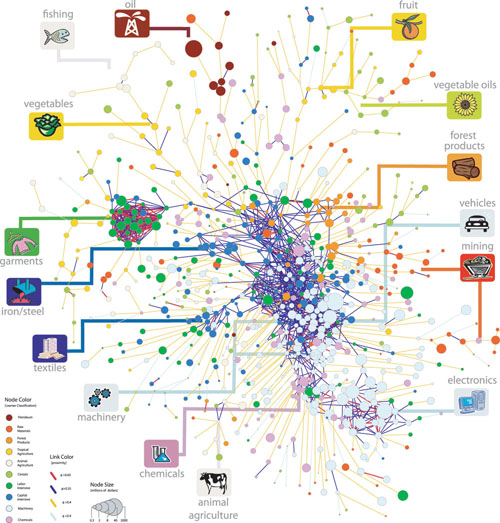
The international “product space”
Image by César Hidalgo
The current research builds on earlier work by Hausmann that mapped “product space” by depicting clusters of product groups according to their relatedness (see graphic above). As an analogy, he says, “Think of a product as a tree and firms as monkeys. There are rich and poor parts of the forest. What you want is to have the monkeys jump from the poor part to the rich part. But in some places, the trees are close together, so it is easy for the monkeys [firms] to move around. In other places, the trees are far apart—this is where the capabilities that go into making one thing don’t help much in making the next thing.” Thus his map of product space shows a large cluster around capital-intensive goods such as machinery and chemicals, with similarly dense clusters around electronics and garments. Rich countries are active in these clusters. Mining, by contrast, is an isolated industry. “Africa is only in the sparse part of the forest,” explains Hausmann. “Countries get trapped because they are in a sparse part of the product space.”
When a country with many complex capabilities adds a new capability, that can a create a range of new possible products. But adding a single new capability in a country that has few to begin with won’t leverage an existing matrix of capabilities in the same way—it might not produce any new products at all.
The field of economics has dealt with the obvious complexity of the world by summing things up with aggregate measures such as GDP. But “as you aggregate, you destroy information about the structure,” Hausmann points out. “In some sense, what we are finding is that the level of production is explained by the structure of production.” Their research implies that economic-development strategies should focus on helping countries find ways to coordinate the generation of linked capabilities and products—preferably by establishing clusters in the denser parts of the product forest.


