Through the pages of the bimonthly Harvard Magazine and online, we report on the intellectual work of the University—one of the premier research and teaching institutions in the world—and help keep alumni, faculty, staff, and other readers informed about the events and policies that will shape Harvard’s future, affect higher education, and influence the wider world. We also help maintain a vital sense of community among the alumni, whose relationship with their alma mater is strong throughout their lives. And our accessible website, harvardmagazine.com, complements the print magazine with regularly updated news reports, features, and multimedia content to serve alumni and interested readers worldwide—providing the context that has been a hallmark of the magazine’s journalism and fully maintaining our editorial objectivity.

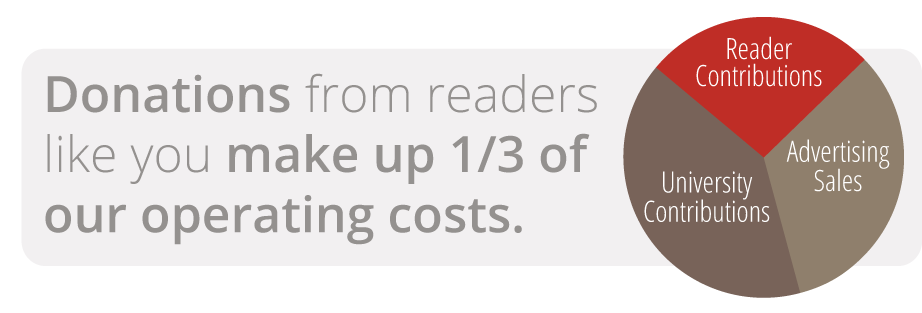
Every year, we receive one-third of our operating budget from private donations, one-third from the University, and one-third from advertisers. As a hybrid business, the magazine has been diligent about managing its expenses: for nearly the past two decades, revenue and staffing have been held essentially level.

In every way, we seek to make the most efficient, effective use of the resources available. Rising costs for increased circulation; higher postal rates; investments in technology, including creation and operation of the website and other online operations; and compensation have been largely offset through use of in-house production technology; aggressive contracting for paper supplies and printing and mailing/distribution services; and tight control of staffing.

In light of economic circumstances and technological change, we believe that the magazine will continue to face both real constraints on revenue and rising demands to get information to you in multiple ways.

We are dedicated to creating a Harvard Magazine of the highest quality. Your donations ensure the magazine’s service to you and help us extend awareness of the University’s contributions to others in the community and the world. Journalism of this quality and depth, like the University’s superb research and teaching, requires additional support. We hope you, our readers, will continue to support the magazine’s unusual, invaluable freedom to report on your behalf with editorial independence and integrity.
FAQ

Q: How is Harvard Magazine funded?

A: Harvard Magazine raises two-thirds of its operating revenue from reader contributions and advertising; the remaining one-third is a subsidy from the University. Visit our Financial Update page for details.

Q: Why does Harvard Magazine need money if Harvard University is so wealthy?

A: Harvard Magazine’s current arrangement with the University—to fund the magazine primarily from non-University sources—maximizes editorial independence. This allows for publication of a high-quality periodical and minimizes financial claims on the University, which is always mindful of its core educational purpose as a research and teaching institution, and does and should apply its resources to the classroom, the lab, the libraries, etc.

Q: What is editorial independence? What is Harvard Magazine’s relationship with Harvard University?

A: The magazine was founded independently by alumni more than a century ago, and is published today by a separately incorporated nonprofit affiliate of Harvard University. We have excellent access to University news and news sources, but are written, edited, and produced—like any independent news medium—with readers’ interests foremost in mind. That is to say, the magazine is not published with the aim of promoting financial donations to the University, as development and other publications properly are.

Q: How is the money spent?

A: Contributions from readers pay for the equivalent of all author and artist fees, and for editing, designing, and preparing the contents of each issue for publication. Revenues from all sources pay for writing, editing, designing, printing, and mailing a quarter-million magazines six times a year to readers worldwide.

Q: What is “Friends of Harvard Magazine”?

A: The “Friends of Harvard Magazine” group was established to demonstrate the appreciation Harvard Magazine has for donors who make an especially generous contribution of $100 or more. Friends members receive invitations to special events; see photos from past events here.

Q: How can I make a donation?

A: You can make a donation online or mail your donation (check payable to Harvard Magazine) to: Harvard Magazine, Attn: Fundraising Department, 7 Ware Street, Cambridge, MA 02138.

Other Ways to Support the Magazine

Planned Giving

For many donors, a bequest is the most realistic way of making a significant gift to the magazine.

An unrestricted bequest intended for the general purposes of the magazine may read simply:

I give (_______dollars/_______percent or all of the residue of my estate) to Harvard Magazine, Inc., a Massachusetts charitable corporation.


Harvard Magazine is a registered 501(c)(3) tax-exempt organization. Our tax identification number is 04-6112-308. Please contact us directly for more information via e-mail at felecia_carter[at]harvard [dot] edu or by phone at (617) 496-6694.

Special Restricted Gifts

Special gifts from alumni have enabled Harvard Magazine to expand its coverage in ways that would have been impossible otherwise. To find out more information about how you can make an impact with a special gift, please contact Felecia Carter at (617) 496-6694. Read about some of these special gifts here.

Appreciated Securities

The Harvard Management Company handles the transfer of securities for Harvard Magazine. For more details, you can contact them at 1-866-845-6596 or the fundraising department of Harvard Magazine at (617) 496-6694.

Matching Gifts

Increase the value of your gift by donating through your company’s matching gift program. To find out if your company (or your spouse’s) has a matching gift program, ask your human resources office. Please contact us by phone (617) 496-6694 or by e-mail (felecia_carter[at]harvard [dot] edu) if you have further questions.

Your independent source for Harvard news since 1898 |