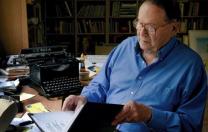
At age five, Ellen Wilbur asked her parents for a typewriter for Christmas. Pecking at its keys, “I was in heaven,” she recalls, “sitting in that same pose I now fall into, trying to put things into words.” Decades later, her father, poet Richard Wilbur, offered a paternal perspective on Ellen’s fledgling struggles with language and art in his poem “The Writer” (see sidebar). “From the first, we knew Ellen had a gift, and told her so,” he says. “But I don’t think she has learned anything from me—she’s a natural writer. She has a perfect sense of narrative structure that I don’t have at all; it amazes me.”
Editors and fellow authors have concurred. A short-story writer, Ellen Wilbur, a Bunting Institute fellow in 1990-91, has a small, finely wrought body of work published in prestigious venues such as Ploughshares, The Virginia Quarterly Review, Shenandoah, The Georgia Review, The Harvard Review, The Yale Review, Agni, and New Letters. Her fiction has been included in eight anthologies, including two Pushcart Prize volumes. In 1984, Stuart Wright’s Palaemon Press Limited published Wind and Birds and Human Voices. “Skilled, sensitive, and daring in their reach,” wrote Eudora Welty of this collection of her short fictions, “they are clearly the work of a born writer.”
Early on, Ellen Wilbur tried writing a novel, but soon recognized short fiction as her métier. “The whole excitement of a short story is the tension in it,” she explains. “Every word is important. When it works, it’s thrilling.” (Her father has written only one short story in his career, in the New Mexico desert in 1952. He comments that “the result, shall we say, was rather arid.”) The yarns Richard Wilbur invented to tell Ellen and her brothers when they were children helped fuel her affinity for fiction. “He taught me the joy of imaginary play,” she says. “He made the mind and imagining things more fascinating than anything else.”
Today, Wilbur supervises the after-school program for beginners and kindergartners at Shady Hill School in Cambridge. She has also edited The Consolations of God (Eerdmans, 2003), a collection of sermons by Phillips Brooks, A.B. 1855, S.T.D. ’77, who was, for more than 20 years, rector of Trinity Church in Boston, where she worships. (“Even in print, and at the remove of a century, Brooks sounds well,” wrote Pusey Minister in the Memorial Church Peter J. Gomes in a foreword, “which is no small thing when few sermons last beyond lunchtime.”) Wilbur has even ventured into verse. “If you can believe it, I started out writing poetry,” she says. “I had the nerve and the gall and was utterly fearless. Maybe it was because I was a girl—or my father was so good that I didn’t worry about comparisons.”