
Main Menu · Search ·Current Issue ·Contact ·Archives ·Centennial ·Letters to the Editor ·FAQs

Please note that, where applicable, links have been provided to original texts which these letters address. Also, your thoughts may be sent via the online Letters to the Editor section.
DREAMS AND BRAIN CHEMISTRY
J. Allen Hobson's theory of dreaming ("Dream-Catchers," by Jonathan Leonard, May-June, page 58) explains a dream as much as an account of the firings of the neurons in Shakespeare's brain explains his creation of a sonnet. The point that Hobson misses is that we are all as creative and human when we are asleep and dreaming as we are when awake, our neurophysiology notwithstanding. But the roles of the amygdala (the emotional center of the brain) and the hippocampus (long-term memory center) in dream formation support Freud's idea that our passions and our past contribute in important ways to the dreaming process. Leonard writes about the splicing studies, "The scrambling isn't being done to hide forbidden thoughts, it's being done for some other purpose." But I would maintain that the jury is still out on the question as to whether we are indeed "conflict free" in dreaming sleep.
Arnold D. Richards, M.D.
Editor, Journal of the American
Psychoanalytic Association
New York City
How left-brained an angle Jonathan Leonard used on the topic of the dreaming mind. One would like to believe that the mind is experiencing something more significant than the interaction of norepinephrine, serotonin, and acetylcholine.
Allan Hobson believes that "we need something more humanistic and all-embracing than neurobiology. A new, scientifically responsible but humanistic psychology would be of immense benefit." Ironically, Leonard's article focuses only on proving that dreaming is nothing more than a simple bodily function.
I was disappointed (but not surprised) to find absent any mention of the power of dreams as a catalyst for scientific or creative endeavors. For instance, the German chemist Friedrich Kekulé von Stradonitz, who discovered the atomic structure of benzene, envisioned the closed-carbon shape of the molecule in a dream of a snake grasping its own tail. From this dream he saw carbon molecules in a swirl, finally forming a benzene ring. He had been wrestling with how the benzene molecule could be formed, but had not been able to make it fit from what he knew about valency of the atoms. In another example, Elias Howe dreamt he was in a jungle, surrounded by savages. They lifted their spears toward him, then lowered them. Each spear had a hole in the tip. Howe later invented the sewing machine. This dream inspired him to move the position of the needle's hole from the problematic location of the base to the tip, an aspect of his invention with which he had been struggling.
Not only can dreams be useful in a practical way, they are sometimes precognitive. Both Eastern and Western religions are full of stories about divine messages that appear through dreams. Had the three magi ignored their collective dream-warning to keep secret from Herod the location of the newly born Jesus, and to return to their home by an alternate route, they would have altered history as we know it.
I disagree with those who believe that our dreams are nothing more than three neurochemicals doing a dance while we sleep. Dreams are communication from our unconscious mind. They make us aware of underlying feelings and situations. For the past eight years, I have recorded my dreams in a journal or on audiotape. Many times I believed a dream was meaningless, until months or a year later, upon re-reading or re-hearing these entries, I am shocked that my subconscious was quite aware of events occurring at the time of the dream, while my "waking" self was, ironically, in the dark. The more one studies his/her dreams, the more one can learn from them.
Jennifer Lapierre, A.L.M. '97
Somerville, Mass.
DISTRESSED HUMANITIES
In "The Market-Model University" (May-June, page 48) James Engell and Anthony Dangerfield document the decline and demise of humanities and social-science departments ("a steady loss of respect, students and...money"; "the systematic devaluing of humanistic study in higher education") and ascribe the ascendancy of other disciplines more or less to the venalities of students and administrators.
Remarkably, in their closing, the authors also arrogate exclusively unto the humanities and social sciences (collectively here, "the humanities") the sole stewardship of language mastery; the ability to "put together a sound argument and blow a specious one to bits"; and profound revelatory knowledge of the human experience. If this degree of hubris is endemic to these fields, that in itself might suffice to explain part of the declines lamented in the article.
The authors spend but a sentence or three glossing over topics which, because of their power to explain much of the downgrading of the humanities, might better have occupied many pages of the article.
I would suggest that, over the years, the leadership of the humanities relinquished much of its claim to pedagogical authority and "traditional eminence in the academy" by not instantly, loudly, and relentlessly denouncing the egregious, precious frauds among postmodern teachings. In the competition of ideas, and in competition for students, the hard sciences and professions move forward on the relatively firm, dry roadway of cumulative, largely self-correcting, generally objective knowledge and induce followers to do likewise, while much of the humanities community has attempted to swim in political and postmodernist muck, in a ditch along the side of the road. Perhaps the results, in part through the data cited in the article, are speaking for themselves.
The humanists appear not to have troubled to learn enough about the sciences to correctly point out the genuine weaknesses and limitations thereof, and are now suffering as a result. The hard sciences, in contrast, are exceedingly cruel masters, as any dabbler or successful, authoritative practitioner knows only too well.
One might suggest that, to embark on a more successful path, the humanities need a fundamental revolution in thinking: for example, they must demonstrate the courage and humility to accept and even teach that, all other things being equal, the outcomes of experiments in physics, chemistry, and biology are the same regardless of whether the experimenter is, say, a Mother Teresa type, Betty Friedan, former Senator Robert Packwood, or Idi Amin. Lacking this foundation, it is difficult to see how major portions of the humanities can possibly hope to reintegrate themselves into the flow of the modern world and reclaim a position of eminence in the academy of human affairs.
Thus, a diagnosis for the maladies of the humanities complained about by Engell and Dangerfield: the patient exhibits the syndrome described by C.P. Snow, namely a morbid allergic reaction to the hard sciences and associated domains.
Prescription: each day take several doses of E.O. Wilson's Consilience and rub some Snow on the arms and chest; then call back in a few years. Do not miss a day of treatment--remember, The Money seems to be working against the humanities.
Paul E. Driedger, Ph.D. '79
Woburn, Mass.
I commend Engell and Dangerfield for their astute exposé of the moribund state of the humanities. Their pointed warning notwithstanding, it is inevitable that the dehumanizingly Darwinian--dare I say Promethean?--struggle humanities graduates face to secure viable, relevant careers inside or outside of academe will continue, as it has for decades, to have grievous consequences for both higher education and American culture at large. There is also a deeply personal dimension to this crisis which the article in question did not address. I offer myself as a case study.
After earning my A.M., I decided to postpone further graduate study and seek immediate employment, confident that my Harvard credentials would at least secure me a full-time position at Miami-Dade Community College, where most of the professors had only master's degrees. When I accepted a part-time teaching job at their inner-city campus shortly after I graduated, I believed I was taking the first steps toward a promising career. I soon learned, however, that an alarming percentage of the faculty were poorly paid part-timers like me, with virtually no hope of obtaining permanent full-time posts with benefits.
Since the odds of getting a tenure-track position in music even with a doctorate remained dismal, after six years of academic "temping" I opted to return to graduate school to earn a master's degree in landscape architecture. Administrators at Florida International University quickly recognized my scholarly abilities, and even before I completed my M.L.A. there in 1991 I found myself once more teaching college courses for little pay. Because of my outstanding performance, I was induced to stay on after graduation--but still on an adjunct basis.
Last year the new dean (read: ceo) of the school of architecture, whose starting salary was a whopping six figures, decided not to renew the "optional" student-services position for which I had received $33,000. Meanwhile he had his office redecorated, hired an additional personal secretary, and advertised for a new assistant dean. In exchange for my exorbitant salary, I personally advised more than 500 existing and prospective students and taught four undergraduate history courses. There were still no benefits.
It has been 20 years since I graduated from Harvard and, much to my dismay, I find that I have spent my entire career as an academic "temp." Unemployed for the better part of a year, at age 46 I am still casting about for a job consistent with my credentials, aesthetic sensibilities, and personal ethos. A dogged humanist, I suppose I am either remarkably persistent in my pursuit of beauty and truth or, in this Age of Money, risibly anachronistic. Relegated by a greed-intoxicated society to a swelling underclass of superannuated scholars, symphonists, and sonneteers to whose wholesale disenfranchisement your authors have so eloquently spoken, I am but one of many whose passion for culture has exacted a heavy price increasingly few are willing to pay.
Joseph D. Ford, A.M. '78
Miami
The authors deplore the decline in student enrollment and faculty in the humanities, but do not offer an answer. We propose a solution which reflects market forces and product costs.
The solution is to charge less for humanities courses, in view of their lower costs, than for other subjects. To a university, courses in the humanities cost less on average because the teachers' salaries are lower and the teaching load is higher. Hence the humanities are in effect subsidizing other courses.
The case is analogous to a company's pricing that is based on "average costing" across a broad range of products. As a result, the company loses money on some products whose true costs are higher than the accounting average, and makes a profit on the lower-than-true-cost products. Companies have gone out of business because a competitor takes away their low-cost product business by underpricing them.
By pricing the humanities courses in relation to other subjects to reflect their actual costs, the evil of average costing is avoided. Harvard's philosophy is "each tub on its own bottom"--each school is self-financing and does not subsidize other schools. Our proposal would extend this down to individual major "divisions," such as humanities, social sciences, natural sciences, and engineering.
Lower tuition for humanities would also be in accord with the consumer's investment decision process. For a variety of reasons, including the heavy burden of student loans, future earnings streams have become a key consideration. Since the financial payoffs from humanities are generally smaller, the rational student wants a lower initial investment in order to achieve the same expected return as for other fields of study. Lowering the tuition would raise the return, and therefore the demand for humanities courses.
Alexander N. Rossolimo, Ph.D. '73
Newton, Mass.
I agree with the facts presented by Engell and Dangerfield, but only in part with the viewpoint. As a practicing research scientist with a background in the classics, I would firmly pin the blame for the decline in humanities specifically on the present miserable lack of foreign language instruction, practice, and requirements. Like the sciences and mathematics, languages have a basic core of facts that must be learnt, and then practiced, and in the practice of a language extensions are automatically made to the societies, cultures, philosophies, religions, etc., used in daily life by these "foreign" people. Foreign-language training forces the exercise of mental faculties as few other disciplines do, and in ways that can be quantified.
Harvard should take the lead in re-raising the bar of foreign-language requirements for college admission. It is not hard to see the connection between the elimination of this quantifiable requirement, and the present profusion of high-school- and even college-degreed individuals who cannot read, write, or think due to lack of training in grammar.
Benjamin M. Blumberg '63
Fort Lee, N.J.
HOMOSEXUALITY AND HARVARD, PART III
Regarding some of the letters responding to Andrew Tobias's "Gay Like Me" (January-February, page 50), I suppose they prove that a Harvard education isn't much of a defense against narrow-mindedness and bigotry, is it?
Glenn Jordan '57
Santa Monica, Calif.
Our headmaster maintained that a gentleman never airs publicly his personal views on religion, sex, or politics. The indelicate subject matter of your last three issues proves vividly that he was right. Surely this offensive discussion belongs to periodicals aimed at the lower orders of society or, as a clinical matter, to the professional journals.
H. W. Gleason Jr., G '49
Shippensburg, Pa.
Last year, around Passover, I came out of a store in Santa Monica to find my car (and all the others) tagged with anti-Semitic pamphlets, the contents of which staggered me with their malevolence. Bitterly I decided that I was glad that I had been so 'enlightened,' in order that I might never delude myself with thinking that anti-Semitism was a thing of the past.
I felt much the same way on reading many of the responses to "Gay Like Me" in Harvard Magazine. Naive, I had not imagined that my fellow alumni, purportedly educated, intelligent people, could hold such virulent or antiquated opinions on an issue that is as much their business as their sex lives are to the gay men (and, no doubt, women) whom they attack. I must settle for being grateful to the magazine for reminding me that, to some, any deviation from what they consider to be the "proper" mores and lifestyle will always be cause for hurtful and dangerous attitudes.
Catherine Cyran '83
Santa Monica, Calif.
You must be doing it right to have received so many letters regarding the article on gays at Harvard. In my view that is what a magazine is all about. If you sail in the middle you get shot at by both sides, but that is how we have our minds expanded. Keep it up!
Judd Goldfeder, M.B.A. '61
Escondido, Calif.
I'm sure by now that everyone on Ware Street has had their fill of responses to Tobias's article. I thought it was outstanding--yet more evidence of how Harvard Magazine has become (in Will Meyerhofer's words) "more interesting lately than it has any right to be." I also agree that, in Tobias's case, the subsequent correspondence has proven at least as absorbing as the article itself. Less shocking to me than homophobic pronouncements was the notion, voiced in several letters, that sexuality itself is an inappropriate topic for public discussion. This would have been a truly alien concept at the Harvard I attended in the late 1980s.
One letter did intrigue me, on another level. The writer mused whether any "fundamentalists" actually read Harvard Magazine. Homophobia and Dr. Socarides aside, I write to assure you that some do. My sense, however, is that we remain more thoroughly closeted than our gay acquaintances. My life since Harvard has developed in ways that I could never have predicted in the Cambridge spring of 1990: I think I'm the only Amishman in the Wadsworth House computer, but I know I'm not alone in having made a religious commitment that most would peg somewhere between confounding and reprehensible. At least one of my classmates at Cabot House left a lucrative banking job for the Jehovah's Witnesses about the same time I joined the Amish; another, at last check, had immersed himself in the much-maligned Boston Church of Christ. Are we, one and all, "people whose Harvard education has failed them" (cf. Ellen Zaslaw)? Or are we proof that when Harvard University decides to foster true diversity, anything can happen? Which, now, is the less publicly addressable topic in Cambridge, sexuality or Christianity?
I merely wish to raise the point. Yes, you probably should attempt that follow-up article on the lesbian experience at Harvard and Radcliffe. When you're done, however, maybe an article on Harvard fundamentalists would be in order? Judging from my own experiences and your current mailbag, it's as culturally needful as Tobias's, and might provoke an even more interesting wave of response.
G.C. Waldrep '90
Yanceyville, N.C.
UNDOCUMENTED ART
I was very disappointed to learn that there are still anti-intellectual dinosaurs like James Cuno in the Harvard museum system ("The Art of Ownership," May-June, page 69). According to his comment, Cuno believes that purchasing looted artifacts is okay, because there is such distance between the purchaser and the looter that it makes no difference how the materials were acquired. Somehow the issue of provenance becomes moot, and questionable ownership is justified, because of the object's esthetic qualities. This specious and facile realization has been thoroughly discredited, and is basically repudiated by the profession at large. Reputable scholars recognize that context is primary, that interpretation is dependent upon context, and that the Greek sites from which the current items were looted are non-renewable cultural resources. Actions such as Cuno's hasten their ultimate destruction, and leave humankind the poorer.
David L. Browman, Ph.D. '70
St. Louis
|
LITTLEST PH.D.
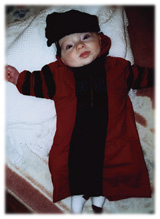
In 1994, my husband, Duane Andre Smith, earned the Ph.D. from the Graduate School of Arts and Sciences. To celebrate his graduation, I made a crimson doctoral gown identical to Duane's for our infant son, Jeremiah Smith, who attended Commencement with us. Countless photographers snapped photos of Duane and Jeremiah, but none of the matching father-and-son shots appeared in Harvard Magazine.
Four years have passed, and we now have another son. Here's Isaiah, wearing the crimson gown with black velvet tam.
Victoria M. Smith, M.Div. '88
Berea, Ky.
IN THE SWIM
Congratulations are in order for the men's swimming team's superb season, which included finishing eleventh at the NCAA meet (May-June, page 90), but this was not "their best ever performance." The 1938 team was undefeated and finished third at the NCAA championships.
Steven S. Berizzi '73
Hartford
The performances for the Harvard swimmers are reported as having occurred at metric distances: 500-meter, 200-meter, etc. However quaint it may seem, NCAA swimming is still conducted in yards. So the times that are reported are for 500 yards, 200 yards, and so on.
If those times had, indeed, been done over metric distances, they would have obliterated the world records. For example, Mike Kiedel's time for 200 yards freestyle was 1:34.94; the world record for 200 meters is 1:46.69. In addition, there is no 500-meter race; the equivalent to the collegiate 500-yard freestyle is the 400-meter freestyle.
Phillip Whitten, Ed.D. '76
Sedona, Ariz.
SOLAR WARMING
Your otherwise informative write-up of Baliunas and Soon's work on solar variability and climate ("Solar Waxing," May-June, page 19) may have left readers with the unfortunate misconception that global warming from anthropogenic greenhouse gases is nothing to worry about, given that (so the story goes) the sun is responsible for most of the observed climate variation to date. In fact, even if Soon and Baliunas are absolutely correct about the role of solar variability, we are in for just the same amount of warming expected from the mainstream scientific consensus embodied in the Intergovernmental Panel on Climate Change reports.
Further, without invoking solar variability, one can explain most of the historical global temperature variation in terms of the combined influence of carbon dioxide and sulfate aerosol--an effect neglected by Soon et al. that is surely worthy of mention. Whether it's solar or sulfates, the real issue addressed by the study is how best to explain the temperature wiggles of the past century, which is something that everybody agrees cannot be done by greenhouse gases alone. Curiously, although Baliunas's and Soon's work has little or no bearing on climate-change policy, it is most often quoted by global warming skeptics in exactly this context. Baliunas's polemics issued under the auspices of the Marshall Institute have, to put it mildly, done nothing to clear up the confusion. Soon et al. could have spared a few sentences in their paper to set the story straight, but didn't avail themselves of the opportunity. I can only hope that the involvement of Texaco, Mobil, and the American Petroleum Institute in funding the work (cf. page 899 of Soon et al.) had nothing to do with this unfortunate omission.
R.T. Pierrehumbert '76
Professor in Geophysical Sciences,
University of Chicago
Chicago
MARY I. BUNTING
I appreciated Nancy Doe Hopkins's remembrance of Bunting ("A Cornerstone of Our Thinking," March-April, page 66). Most students whom President Bunting touched and inspired were, no doubt, Cliffies. But not all. I was one of those Harvard students also fortunate enough to know her.
During my senior year, "Mrs. Bunting" was extremely supportive--morally, intellectually, and personally--of my work with refugees in East Africa and with children in Roxbury, where I was living. She even offered me a room in her home on Brattle Street, to save commuting time, during my final mad dash to finish my senior thesis. I can remember tiptoeing through her front door after a late night at the library, only to find her still very much awake, poring over freshman applications spread all over her living-room floor--and shaking her head with a mixture of joy and anguish as she explained how difficult it was to choose among so many extraordinary young women.
Though I didn't agree with her about some things--and in later years was deeply disturbed by her advocacy of civilian nuclear power, as a member of the U.S. Atomic Energy Commission--I greatly admired her keen and intensely curious mind, her almost child-like eagerness to learn from others (to "pick their brains," as she would say), and her contagious delight in honest, vigorous debate.
But above all, I will remember Radcliffe's fifth president for her overflowing generosity of spirit. Thank you, Mrs. Bunting.
G. Randall Kehler '66
Colrain, Mass.
|
WORLD TREE
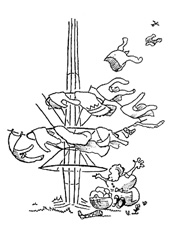
I was particularly pleased to see in "Centennial Timeline" (May-June, page 44) the reference to Thomas Lehrer's comment about Gropius's "world-tree" sculpture. My classmate in the Law School class of '52, Harry Gin, and I penned this poem in our second year, and it was published in the Record on February 7, 1951:
I think that I shall never see
Another such monstrosity.
A tree that looks as if to say
"Oh when, oh when is laundry day?"
A tree that may on Monday wear
A suit of my old underwear.
A tree that canines will ignore
And seek their favorite sycamore.
A tree about which Phil does sing;
At last we know it is the "THING."
Poems are made by fools like me;
But only a greater could make that tree.
Murray M. McColloch, J.D. '52
Plano, Tex.
Editor's note: "Phil" refers to bandleader Phil Harris, who popularized a song about a "thing" (bump-ba-bump).
AMPLIFICATIONS AND ERRATA
You mention that Nathan Pusey was [the first Harvard president] born west of the Connecticut River ("Centennial Timeline," May-June, page 45). Doesn't the honor go to Kirkland?
Christopher Niebuhr '56
Lee, Mass.
Editor's note: John Thornton Kirkland, A.B. 1789 and future Harvard president, was born "in the wilderness of New York," in Oneida, which is considerably west of the Connecticut River.
In "Vita" (May-June, page 46), you use the term "knots an hour." A "knot" means one nautical mile per hour. Knot is a unit of speed (distance traveled, per unit of time), rather than a unit of distance.
Col. Merrill J. King Jr., M.D. '52
West Rockport, Me.
The Italian advertisement reproduced on page 20 ("Radiant Walls") of the March-April issue is wrongly captioned. The novel source of illumination it promotes is not electricity, but the incandescent gas-mantle, invented by Auer von Welsbach, whose name you'll see at the top.
Ian Graham
Cambridge
Tsk! Tsk! The new Business School building pictured in the May-June issue ("Scenes from the Sidewalk," page 77) is not "hard by Storrow Drive." It is "hard by" Soldiers Field Road, which does not turn into Storrow Drive until it gets to the Boston University Bridge.
George H. Hanford '41, M.B.A. '43
Cambridge
The 1958 item in "Yesterday's News" (May-June, page 96g) recalled the decision to permit certain private non-Christian ceremonies in Memorial Church. That led to the all-time great Crimson typo about the first Memorial Church wedding performed by a rabbit.
Walter L. Goldfrank '61
Santa Cruz, Calif.