
Main Menu · Search ·Current Issue ·Contact ·Archives ·Centennial ·Letters to the Editor ·FAQs

An Austrian economics professor invented the postcard-at first a plain slice
of buff cardboard-in 1869. In 1889 the French invented the picture
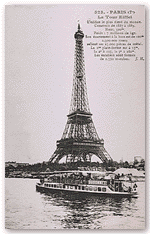
postcard and erected the archetypal postcard subject, the Eiffel Tower,
to put on it. Tourists could buy the card (below right) on site as a keepsake or
mail it to a friend as evidence of worldliness. "Far above Paris-900
feet-I send you a line," went an early message. "We have ascended
the Eiffel Tower; the views are simply magnificent."
The picture postcard soared in popularity, depicting art works, architecture,
scenic sights, great battles of history, famous people, naughty ladies,
and garish hotels in Florida. From the turn of the century to World War
I, the postcard enjoyed its golden age and the collecting of postcards became
a craze. Collections were given to libraries, often as tagalong matter with
bequests of books, and many of Harvard's libraries hold big batches of cards
acquired mostly in this way.
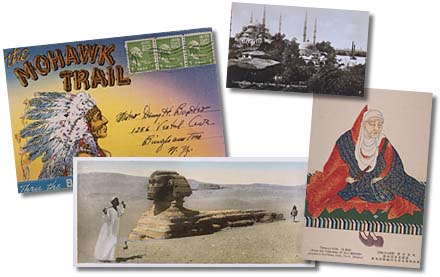
 Melissa Banta is curatorial associate at the Fine Arts Library and Harvard
University Library and has acquainted herself with the more than 95,000
postcards in the fine arts stash. A few are reproduced above-an accordian-fold
packet of Technicolor scenes of the Mohawk Trail, a Sphinx hand-colored
in Cairo, an original woodcut from Tokyo, and a forbidden view of the "Mosquée
du Sultan Ahmed et l'Hippodrome" printed in Constantinople. In
the early 1900s, Turkey banned any postcard showing a mosque, or a Muslim
woman, or the name of Allah, and the sultan's agents confiscated all such
cards in Turkey.
Melissa Banta is curatorial associate at the Fine Arts Library and Harvard
University Library and has acquainted herself with the more than 95,000
postcards in the fine arts stash. A few are reproduced above-an accordian-fold
packet of Technicolor scenes of the Mohawk Trail, a Sphinx hand-colored
in Cairo, an original woodcut from Tokyo, and a forbidden view of the "Mosquée
du Sultan Ahmed et l'Hippodrome" printed in Constantinople. In
the early 1900s, Turkey banned any postcard showing a mosque, or a Muslim
woman, or the name of Allah, and the sultan's agents confiscated all such
cards in Turkey.
The value of postcards may not yet be widely perceived by scholars. But
occasionally librarians see their postcards prove useful. The Fine Arts
Library has the Aga Khan collection of cards, which includes images of Tangier,
among them a card reproducing a photograph taken out a certain hotel window
at the same time Henri Matisse was in Tangier and made several paintings
and drawings of the same view. As the National Gallery of Art did research
for its exhibition "Matisse in Morocco," curators fell upon this
postcard, for it allowed them to compare Matisse's interpretations with
reality, revealed on an old bit of wish-you-were-here ephemera.