
The recent political sparring over immigration reform has included scant mention of cross-border diplomacy. Despite the growing interdependence of the U.S. and Mexican economies over the past few decades, the governments of the two nations have shown little interest in cooperating on the thorny issue of human migration. A brief look at the history of the Mexican-U.S. labor relationship reveals a pattern of mutual economic opportunism, with only rare moments of political negotiation.
The first significant wave of Mexican workers coming into the United States began in the early years of the twentieth century, following the curtailment of Japanese immigration in 1907 and the consequent drying up of cheap Asian labor. The need for Mexican labor increased sharply when the Unites States entered World War I. The Mexican government agreed to export Mexican workers as contract laborers to enable American workers to fight overseas. After the war, an intensifying nativist climate led to restrictive quotas on immigration from Europe and to the creation of the U.S. Border Patrol, aimed at cutting back the flow of Mexicans. But economic demand for unskilled migrant workers continued throughout the Roaring Twenties, encouraging Mexican immigrants to cross the border—legally or not.
 |
Janet Jarman / Corbis |
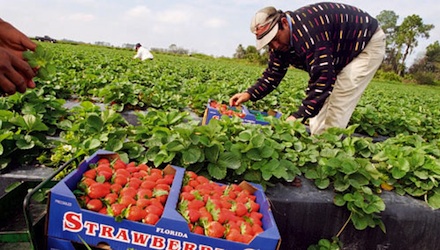
A 43-year-old migrant worker picking strawberries in Florida, 1997. Migrants have long called strawberries frutas del diablo (fruits of the devil) because picking them ranks among the lowest-paid, most labor-intensive types of farm work. |
The Depression brought a temporary halt to the flow of Mexican labor. During the early 1930s, Mexican workers—including many legal residents—were rounded up and deported en masse by federal authorities in cooperation with state and local officials. Mexicans became the convenient scapegoats for widespread joblessness and budget shortages; as Douglas Massey, Jorge Durand, and Nolan J. Malone point out in Beyond Smoke and Mirrors (2002), Mexicans were accused, paradoxically, of both “taking away jobs from Americans” and “living off public relief.”
The demand for Mexican immigrants reemerged after Pearl Harbor, when the U.S. government sought an agreement with Mexico to import large numbers of Mexican farm laborers. Known as braceros, these workers would ensure the continued production of the U.S. food supply during the war years. “It was Mexicans and Rosie the Riveter who ran the American economy and enabled American citizens to go to war,” explains vice provost for international affairs Jorge Domínguez, Madero professor of Mexican and Latin American politics and economics.
Although intended as a wartime arrangement, the Bracero program continued under pressure from U.S. growers, who feared a continued labor shortage in the booming postwar economy. Still, the numbers of legal braceros fell short of demand, and growers began regularly recruiting undocumented workers to tend their fields. By the end of the Korean War, illegal immigration had become a fixture of the U.S. agricultural economy—and public sentiment had again turned restrictionist. In 1954, the U.S. government responded with “Operation Wetback,” apprehending close to one million illegal workers. Meanwhile, to appease the growers, the Immigration and Naturalization Service (INS) reprocessed many of these undocumented Mexicans and returned them to the fields as legal braceros.
In the early 1960s, with the advent of the civil-rights movement, public opinion began to view the Bracero system as exploitative and detrimental to the socioeconomic condition of Mexican Americans. The government ended the program in 1964. But growers were still hooked. “The problem of Mexican illegal immigration is born at the moment that the Bracero program ends,” Domínguez explains. “[Mexicans] keep coming, because the demand is still there.”
Following the Hart-Celler Immigration Reform Act of 1965, which removed the racially based quotas on immigration set up in the 1920s, Mexicans for the first time had to compete for visas with immigrants from other areas of Latin America and the Caribbean. Rapid population growth and declining economic conditions in Mexico coincided with a reduction in the legal cap on Mexican immigration beginning in 1968, causing the numbers of undocumented workers to soar.
As the problem of illegal immigration worsened through the recession-plagued 1970s, the prospect of diplomatic talks between Mexico and the United States grew less likely. The Mexican government saw little to gain from cross-border negotiations at a time when restrictionist voices in the United States were gaining ground. As Domínguez explains, “[The Mexican government] realized they had a stake in Mexicans going abroad, exporting the underemployment problem.” They also feared that any discussion with the United States would involve “linkage”—that is, that the United States would tie trade concessions to Mexico’s improved control of the border. This pattern of political avoidance continued into the 1980s. In 1986, when the United States passed the Immigration Reform and Control Act (IRCA), “there was no Mexican government voice in the process,” Domínguez points out.
The passage of the IRCA set the stage, many observers believe, for the enormous and entrenched problem of undocumented immigrants that exists today. While granting amnesty to 2.3 million Mexicans residing illegally in the United States, the law began a process of border fortification and militarization that has had the opposite of its intended effect. The idea of building a wall—which began under the Clinton administration—turned a pattern of circular migration into one of permanent settlement. “Now ‘Once I make it, I’m not going back,’” Domínguez explains. As Princeton sociologist Douglas Massey pointed out to the Senate Judiciary Committee in 2005: “From 1965 to 1985, 85 percent of undocumented entries from Mexico were offset by departures and the net increase in the undocumented population was small. The build-up of enforcement resources at the border has not decreased the entry of migrants so much as discouraged their return home.”
Ironically, while the ratification of the North American Free Trade Agreement in 1994 heralded a new level of economic integration between Mexico and the United States, the question of labor migration remained off the table. “Even as binational trade with Mexico grew by a factor of eight from 1986 to the present,” Massey points out, “the Border Patrol’s enforcement budget has increased by a factor of 10 and the number of officers tripled. The U.S. Border Patrol is now the largest arms-bearing branch of the U.S. government save the military itself, with an annual budget of $1.4 billion.”
In 2000, a year in which both countries elected new presidents, Mexico finally took the initiative to launch discussions on immigration. President George W. Bush seemed open to a policy along the lines of the Bracero agreement. “But the Mexicans overreached,” Domínguez explains. “They wanted to deal with everything, including the status of Mexicans already here.” The United States said no, and after 9/11, the Bush administration lost interest.
The recent stalemate in the U.S. debate on immigration reform has stalled the possibility of diplomatic talks with Mexico, at least for now. The United States may have to resolve its internal contradictions on the subject of Mexican labor before any substantive cooperation with the Mexican government can take place.


